Toyosu Tuna Auction Times: The Full Morning, Minute by Minute
The Toyosu tuna auction runs about 5:30–6:30am on market business days. Which days it's closed, when to arrive, and how the pre-dawn morning actually unfolds.
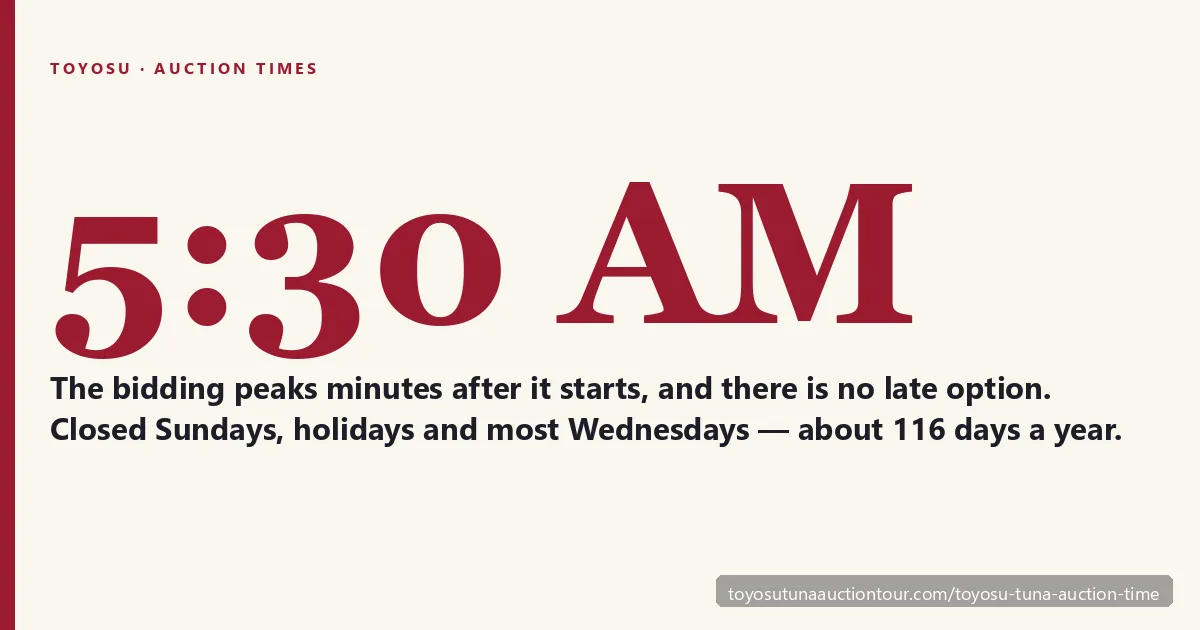
The short answer: the Toyosu tuna auction runs from about 5:30am to 6:30am, and the part worth setting an alarm for happens in the first half of that window. The long answer — which days it doesn’t run at all, when the doors actually open, and what each quarter-hour of the morning looks like — is the difference between a great morning and standing in a corridor watching forklifts.
The timeline that matters
| Time | What’s happening |
|---|---|
| Before 5:00 | Buyers are already on the floor inspecting fish laid out overnight. Visitors wait outside the Fisheries Wholesale Market building. |
| Around 5:00 | The visitor corridor opens. Early arrivals claim the best glass on the upper observation windows. Lottery winners are escorted to the lower deck. |
| Around 5:30 | Bidding begins — bells, chants, hand signals. This is the peak. |
| 5:30–6:15 | Lot after lot sells at trading speed. Sold fish start leaving the floor on carts. |
| Around 6:30 | The auction winds down; the floor becomes logistics. Nothing left to see but cleanup. |
| From 6:30 | The market’s restaurants are open — sushi breakfast from stock that was on the floor an hour earlier. |
Two rules fall straight out of that table. Arrive by 5:00–5:15, because the difference between 5:15 and 6:00 is the difference between theatre and tidying. And there is no late option — no afternoon session, no second sitting, no version of this at a civilised hour.
Which days the auction runs
The auction happens on market business days — and Toyosu’s calendar is built for the fish trade, not for visitors. The market closes on:
- Every Sunday
- Public holidays
- Most Wednesdays — irregularly, following the wholesale calendar
Add it up and Toyosu is shut roughly 116 days a year, which is why the Wednesday trap catches so many well-planned trips. If your one free morning in Tokyo is a Wednesday, check the market’s published calendar for that specific date before committing — or book a guided morning, since a live operator won’t sell you a date the market is closed, which is one of the quieter things you’re paying for.
Seasonal wrinkles
Late December is peak trade: the run-up to New Year is the busiest, most crowded stretch of the market’s year, and visitor arrangements can be modified. The featured tour’s own operator flags December bookings with exactly this caveat.
Early January brings the famous ceremonial first auction — the one that makes headlines, like January 5, 2026, when a 234kg bluefin from Ōma sold for a record ¥510.3 million (about $3.2 million) to the Kiyomura group behind the Sushi Zanmai chain. Kiyomura’s president admitted afterwards he had expected to win at ¥400 million “but before we knew it the price was soaring” — because the first fish of the year, the ichiban maguro, is a corporate prestige contest as much as a purchase. His rival bidder was acting for the Onodera restaurant group, whose buyer had taken the top fish five years running, including 2025’s at ¥207 million. Worth knowing about; not worth planning around. It is a press event layered onto a trade, the market is at its most crowded and visitor arrangements tighten, and on any ordinary Tuesday the auction below you is the same ritual at sane prices.
The rest of the year, the auction is remarkably consistent — same hour, same rhythm, winter dark or summer light. The bluefin trade does not have a low season.
The 4:30am problem
Whatever the calendar says, the clock is the real obstacle. The auction peaks before Tokyo’s transit network is properly awake, and Toyosu sits on reclaimed land in Tokyo Bay — Shijō-mae Station, on the Yurikamome line, is the stop, but trains at that hour won’t reliably put you at the glass before the bidding starts.
Realistically you have three options: a taxi (the featured tour’s operator is blunt about this, and recommends staying near Toyosu, Tsukiji or Ginza to keep the fare short), a hotel within walking distance, or a guided morning where the meet-up is the operator’s problem — at your hotel or at the station, before dawn, with the route planned. The full logistics rundown, including doing it entirely solo, is in how to see the auction.
After the auction: don’t waste the hour you just won
You will be fed, wide awake, and standing in a working market district at 6:30 in the morning — an hour when almost nothing else in Tokyo is open. The correct move is the market itself: breakfast at the counters upstairs, then across to the Tsukiji outer market, 2.5km west, which never moved and whose food lanes hit their stride from 8am. The featured private tour makes that crossing by local bus with a guide who knows the stops; done solo, it’s a short taxi or an easy bus ride.
However you do it, sequence matters: auction first, breakfast second, Tsukiji third. Run it backwards and you’ll have missed the fish.
Ready to Book?
The private morning featured on this site handles the whole timeline — pre-dawn hotel or station meet, the auction at its 5:30 peak with live narration, the professional market floor, breakfast, and the bus to Tsukiji. Your group only, up to ten people, rated 4.8/5 by 268 verified guests, from about $151 per person with free cancellation. Check availability →
The Auction at 5:30, Breakfast by 8, No Guesswork
A private guide for just your group — hotel or station meet before dawn, the bluefin auction explained while it happens, the professional market's knife and matcha shops, a sushi breakfast, and the bus across to Tsukiji's food stalls. Rated 4.8/5 by 268 verified guests. From about $151, free cancellation.
Check Availability & Book